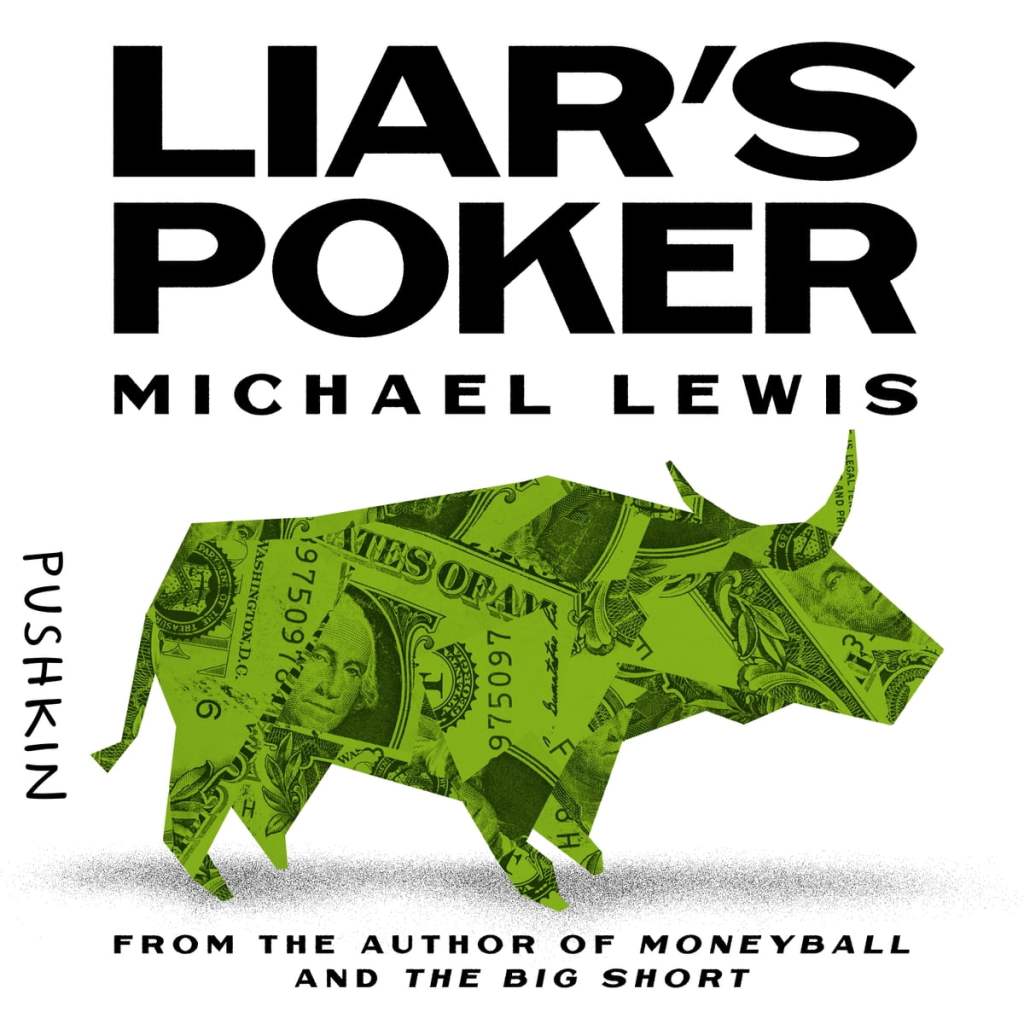
Where do I even start? As soon as I started reading this book, it felt like I was transported into the raucous 41st trading floor of Salomon Brothers in New York City. The palpable energy emitted from the pages made me feel as if I was sitting in those exact seats, executing trades on behalf of my clients. In addition, the fast pace and vivid character development in Lewis’s book kept me at the edge of my seat the whole story – as I finished this book in only two days.
Having always been intrigued by a career in Wall Street, I became fascinated with the anecdotes Lewis shares in his telling of his storied career. From how he befriended a managing director’s wife at a royal family event to the inner workings of Salomon Brother’s mortgage back securities department, this book never has its dull moments. Thus, it is interesting to witness the growth of Lewis’ career chronologically, ever since he started as an art history major in Princeton. Therefore, if there was a book that accurately summed up Wall Street in a humorous, causal yet informing manner, this would be it.
The name of the book derives from a classic game traders used to and still do play. Everybody sat in a circle with a dollar bill on their chest. On each bill was an eleven-digit serial code which consisted of both numbers and letters. The game usually starts with a person saying something along the lines of “one eight and one A”. This meant that he believed everybody in the circled had both one eight and one A on their serial codes. As the game progressed, you bet higher and higher, either on numbers or letters. For experienced players, calculating the probabilities isn’t the hard part. The hard part comes with knowing what the opponents are thinking and taking advantage of that information to beat them. Every game of Liar’s Poker has a fool, a sheep, and a wolf. It just happened that everybody was a wolf on that trading floor.
This is just one example of an unfiltered glimpse into Lewis’s world of finance. I laud Lewis for his vulnerability in truthfully depicting the characters, deals, and relationships he had made in the firm. However, from his stories emerges a recurrent theme that continually pops up within any account of financial literature: greed. To which I’d even argue innovation and reputation follow closely behind.
In fact, greed is exemplified by one of my favorite quotes in the book:
“You don’t get rich in this business. You only attain new levels of relative poverty”
Page 239
For Lewis, this short-sighted greed became activated when he was assigned to unload AT&T bonds that were losing money for the firm. The firm had been trying to sell these bonds for months but there was no buyer in sight. Pressured by management, Lewis was able to convince his only client that the bonds were undervalued. However, the unlucky buyer lost $60,000 overnight despite Lewis’s ‘meticulous’ investment thesis. In the moment, Lewis claims to have lost his innocence. Yet instead of guilt, he felt relief. For me, it was almost as if I saw Lewis undergo metamorphosis, dawning on me that people will do almost anything to get ahead.
However, greed can also manifest itself in another form: innovation. This was represented by the invention of mortgage-backed securities in the 1980s. Prior to the 80s, each mortgage was guaranteed by any Savings and Loans. In hindsight, not only was this extremely inefficient, but the biggest issue was also that homeowners could pay their mortgages back early. This shortens the interest-earning duration, as investors got their money back with nowhere to park it. Therefore, the traders at Salomon Brothers took out the middleman and began packaging mortgages with similar characteristics into different tranches to sell to investors with differing risk appetites. Just like that, the problem was solved and money flowed.
Thus, with graduates fresh out of college making more than tenured professors with doctorate degrees, it makes you reconsider the notion that one’s pay is proportional to one’s marginal value contribution to society. If such distribution can be skewed, so can the incentives. Soon enough, the strangle hold Salmon Brothers had on mortgaged-backed securities weakened as traders left due to internal strife. This decline in profits was exacerbated by further financial innovation: junk bonds. On the other side of the street, Michael Milken’s invention of junk bonds allowed non-creditworthy borrowers to take out loans, fueling the buyout frenzy allowing corporate raiders such as Carl Icahn and Nelson Peltz to thrive. With investors searching for higher yielding investments, funds pivoted from mortgage securities and into junk bonds that delivered higher rates of returns. Thus, if there’s one thing I learned from this story, it’s that nobody can stand atop the mountain forever. Eventually, somebody is going to come and knock you off the summit, sort of like survival of the fittest.
This is where the importance of reputation comes in. Salomon traders were known for their extremely profitable business model and the ruthless methods they would earn their commissions. However, they were also resistant to change and often short-changed clients for short-term gains. Soon, rumors spread and people caught on to their predatory business tactics, which eventually caused the firm to be bought out in 1997. Therefore, a firm’s or even an individual’s reputation in conducting business is paramount to future success, especially when word of mouth can spread like wildfire.
Themes aside, I’ve been thinking how this book applies to my personal life. First, the direct implications are obvious. Financial regulation have tightened extraordinarily. With the introduction of the Basel Accords, an expanded mandate of the Federal Reserve, and the FDIC, it is very unlikely the scenes depicted in Liar’s Poker are to be repeated. Some argue that these measures disrupt the capitalistic market dynamics, but they only serve to ensure a stable financial system and avoid misaligned incentives. Lessons can also be drawn here. First, finance is a highly political endeavor and success often depends on building alliances and developing a comprehensive network. Secondly, it requires taking risks and being willing to make bold decisions to succeed. Lastly, a reputation is built and earned. It almost seems like a rite of passage to start at the bottom of the totem pole. Yet isn’t that what makes things exciting
Liar’s Poker by Michael Lewis
 Bookmarks and Bullshit
Leave a comment