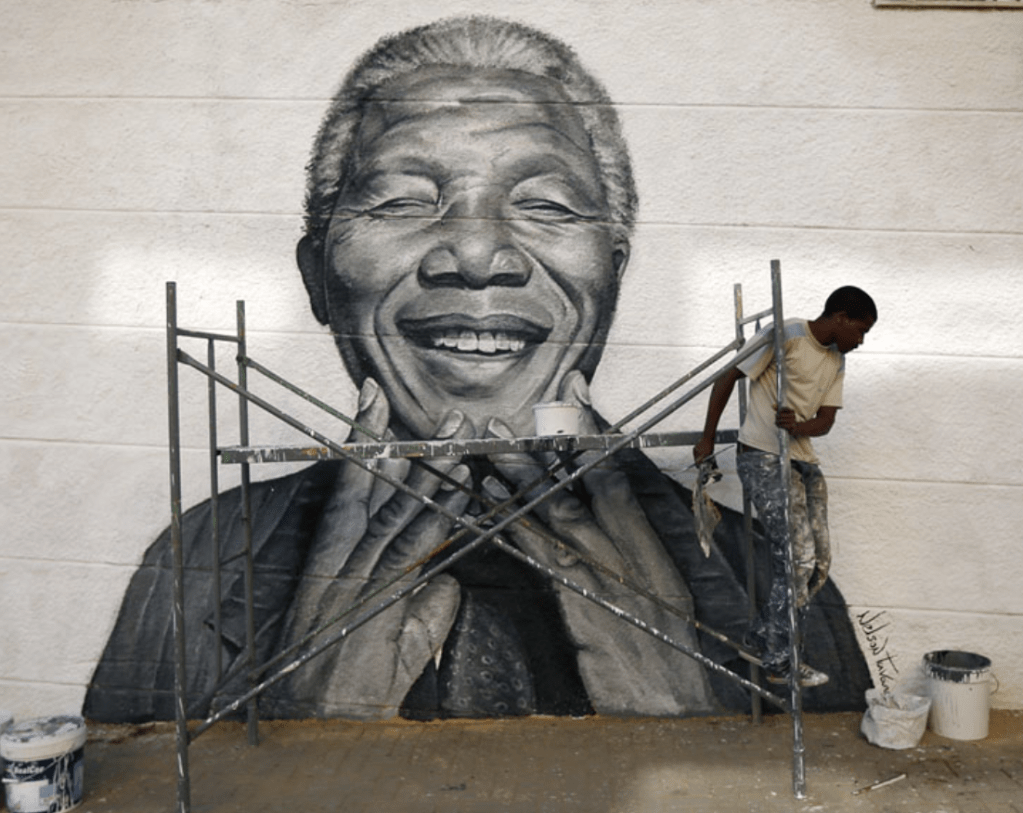
Prompt: To what extent have the ANC dealt with the legacy of apartheid, or have their policies hindered change?
“The past can never be completely erased. It lingers. Like the scent of burning wood.”- James Wesley[1]
Apartheid officially ended with the hard-fought negotiations of 1994, but its lasting effects can still be felt in the most basic interactions of daily life. Therefore, as South Africa continues to grow and become the global hub it is known for today, the legacy of apartheid remains embedded within the inherent power dynamics and constitutional values of the African National Congress (ANC). Being the majority ruling party in South Africa since 1994, its deep entanglement with its segregationist past is forever at odds with the progressive policies of the future. Although some would argue the ANC is unable to break free from these apartheid handcuffs, credit is due to the party as they have made considerable progress in improving the livelihood of its populace. On the most rudimentary level, changes are being implemented within housing, infrastructure, sexual violence, crime, and the economy. However, with recurring and repetitive broad-based government policy enactments, it is not only hard to keep track of the dizzying number of acronyms, but even harder to measure success.
Therefore, many questions arise with vague nature of the prompt. For example, what does it mean to deal with apartheid? Against what criteria? And within what time frame? As a result, this paragraph aims to define the scope of the author’s interpretation of the question before presenting its thesis. First, I define ‘dealing with the legacy of apartheid’ as the government’s attempt to phase out the “outdated mindset of race superiority and rights” through collective economic empowerment.[2] Secondly, because the question pertains to the ANC’s management of apartheid, the residing presidents and their respective economic policy prescriptions will be examined. The reason is that thoughtful economic policies serve as an overarching solution while also addressing a host of other problems through secondary, trickle-down channels. Lastly, the paper limits the legacy of apartheid from 1999 to 2014. This period intentionally excludes Mandela’s presidency from the five years after 1994 because this timeframe doesn’t qualify as a ‘legacy’ but more of an immediate aftereffect.[3] It could also be argued that this period’s considerable use of symbolism only offered a band-aid solution rather than lasting change. In addition, Cyril Ramaphosa’s presidency from 2017 onwards is excluded because his reign is complicated by COVID-19, which has hindered the implementation of the ‘New Dawn’. Therefore, from this narrower perspective, success can finally be defined by a South Africa with high levels of foreign direct investment, a productive and inclusive labor force, little to no corruption, and low levels of poverty.
Hence, this paper is split into two sections to separately examine the intended and actual effectiveness of Thabo Mbeki’s Growth, Employment and Redistribution Program (GEAR) and Jacob Zuma’s Radical Economic Transformation Initiative (RET). With a combined eighteen years in office from 1999 to 2017, the two presidents and their respective policies offer a glimpse into a nation struggling to deal with the cruel aftermath of its past. Therefore, the legacy of apartheid hasn’t been eliminated, but rather morphed into different manifestations to suit the needs of politicians in power. Masked under catchy slogans and new acronyms, apartheid became privatized under Mbeki’s “neo-liberal” leadership. Furthermore, Zuma’s reign compounded the problem by creating a new, politically exclusionary apartheid under the disguise of state capture. Taken together, South Africa may seem to have taken steps towards change, but it truly remains under the shackles of its previous self, making it hard to be hopeful lasting change is to come.
Mbeki’s GEAR
Despite GEAR’s promotion of a welfare state, it perpetuated the neo-liberal framework, signaling a break from Mandela’s progressive Reconstruction and Development Program (RDP).[4] The policy also handed control of the state towards private actors in a desperate effort to spur job growth, leading to the privatization of apartheid in the early 2000s. This not only meant that state-owned assets were being sold to private investors, but government spending was also being cut by the millions. Overall, his policy saw an increase of foreign direct investment, but at the expense of worsening corruption and inequality.
Neo-Liberal Roots
Mbeki’s ideological roots can be traced to his upbringing. Born in a tiny village on the Eastern Cape, he followed his father’s footsteps by joining the ANC Youth League at the age of 14.[5] After the party was forced into exile, he left, like many, for the Lenin Institute in Moscow. Despite this, he remained loyal to the party by becoming the figurehead of the Rivonia Trials protests in 1964.[6] This catapulted his early career in politics, as he steadily rose through the ranks until he was elected as Mandela’s successor in 1999.
With exposures to an array of economic philosophies having been educated in three countries, Mbeki is often accused of ‘talking left, walking right’. This means that he is inconsistent with the intent of his policy implementations, largely seen to simultaneously please people on either side of the political spectrum. As Professor Patrick Bond of the University of Johannesburg phrases it: “South Africa’s first democratic government is locked into walking right the more its politicians talk left… getting South Africa and Africa nowhere.”[7] Equally important, this has also inhibited the country from taking advantage of the “unprecedented degree of access to the structures of global power.”[8] For example, during WTO’s 2003 meeting, South Africa’s hesitancy towards leading the Southern African Development Community (SADC) in blocking new WTO negotiations raised eyebrows over the policy objectives of the state.[9] The events that unfolded in Cancun were largely seen as South Africa’s chance to place itself among the global elite while also staying true to its African heritage. However, South Africa played more of the role of a puppet state and as a “bridge for the transmission of influences from the developed to the developing countries.”[10] Therefore, this awkward in-between status has left its international reputation in limbo.
Domestically, Mbeki’s GEAR is the epitomization of such ideological inconsistencies. According to a speech given in 2003, he claimed that “if we were to follow the prescriptions of neo-liberal market ideology, we would abandon the masses of our people to permanent poverty.”[11] Amusingly, his brainchild, GEAR, happens to be a “neo-liberal structural adjustment program”, with core tenants including “the rule of the market, cutting public expenditure for social services, deregulation, and privatization.”[12] Moreover, GEAR “was not the product of consultation with the Tripartite Alliance”, generating internal turmoil that has steadily debased South Africa’s reputation as a unified nation.[13]
Although some would argue that GEAR did enact left-leaning programs, such as a strong university pension and grant system, this was overshadowed by a fiscally conservative agenda due to pressure from investors and the new middle class.[14] Realizing the foundations of a strong economy rested upon foreign dollars, the ANC courted international investors by creating a stable, export-oriented country that granted tax breaks and offered low costs of borrowing. However, this induced a positive feedback loop as investors continued to demand favorable macroeconomic environments and credible evidence of its perpetuation. In a fitting quote by Business Day’s Peter Bruce, he claims “the government has become utterly seduced by big business and cannot see beyond its immediate interests.”[15] Similarly, the rise of the black middle class created an unbreakable cycle for the party. Even though the black middle class was “very deliberately engineered by the ANC” to promote consumption and employment equality, they tended to vote conservatively.[16] This meant the ANC became coerced to implement business-friendly policies to appease the voter base it created, thwarting the chance for any meaningful, genuine change.
This is the sad reality South Africa faced under Mbeki’s leadership– the ANC recognized maintaining the status quo will always be the safer option than a radical overhaul. And just like that, Mbeki’s indecisiveness was punished by investors and the rising middle class to further their agenda, laying the groundwork for the privatization of apartheid.
Privatizing Apartheid
As the state was tilted towards cultivating a business-conducive climate, new segregation lines were drawn: this time within the private and public sector. The privatization began with state-owned South African Airways selling 20% of its stake to Swissair for $229 million.[17] Then came telecommunications provider Telkom selling a 30% stake to US-based SBC Communications.[18] Thus, as foreign corporations retained a larger share of South Africa’s assets, the prevailing theory was that this would lead to a more efficient allocation of resources by allowing market forces to dictate the economy, thereby benefiting everyone involved. This worked to an extent, but it wasn’t the whole truth. As seen with the case of water distribution, the neo-liberal framework “effectively forced local governments to turn to commercialization and privatization as a means of generating the revenue no longer provided by the state.”[19] For the natural resource of water, the keys to the country’s faucets were handed to French-owned utility company SUEZ. Almost immediately, water prices rose more than 600% to R60 per month, effectively shutting out the most vulnerable patches of population to the most basic physiological needs. Having no choice but to resort to river water and boreholes, the province of Kwa-Zulu Natal bore the brunt of the injustice with over 120,000 people infected with cholera in 2000.[20]
This wave of privatization struck a familiar chord within most South Africans. Having fought so hard to elect a democratic government just years before, people no longer saw the post-1994 administrations as trust-worthy, but rather a vehicle to fill its own coffers. This idea is parallel to Sizwe Mpofu-Walsh’s “The New Apartheid”. In his book, he asserts “apartheid was dealt a non-fatal blow in 1994”, allowing it to stand again on its two feet, “creating a system of oppression reconstitute[d] around new constraints.”[21] Although the scope of this paper limits the new constraints to the neo-liberal economic order, Mopfu-Walsh’s privatization theory doesn’t end there. He argues all aspects of the state: law enforcement, security, media, and tech, reinforced these oppressive binaries.
To its credit, these ‘new constraints’ promoted job creation and ensured a more equal distribution of capital through Black Economic Empowerment (BEE). Moreover, it created a strong banking system evident with the Johannesburg Stock Exchange’s market capitalization exceeding $1 trillion. However, privatization did not achieve its intended goal of poverty alleviation and eradication of corruption through market corrections. In fact, it exacerbated them. After GEAR was introduced, the vast majority of South Africans remained in poverty with 18.9% of people living on less than $1.90 a day.[22] Some would argue that South Africa was already one of the most unequal countries to begin with (evident with a Gini coefficient of 64.8 in 2005), but the privatization of state assets have only concentrated wealth in the hands of the few, evident with 10% of the population owning more than 85% of wealth. To contrast this with England, the figure stands at 43%.[23] This is concrete evidence that trickle-down economics facilitated by neo-liberalism does not work in South Africa.
In addition, rampant corruption continued to persist within the government. From the Ace Magashule’s asbestos scandal to accusations of Mbeki paying $10 million to FIFA President Sepp Blatter, the examples are boundless. Overall, the rise of corruption cases can be attributed to the one-party system that facilitated high levels of monopolization. However, a more subtle reason of increased corruption is due to the ANC’s privatization policies that excluded public government officials from private spheres. Soon enough, politicians realized corruption was the only way to gain access to the lucrative financial system they have been so desperately shut out of.
All in all, the neo-liberal roots of Mbeki’s GEAR enabled the privatization of apartheid, leaving deep demarcations lines between the have and the have nots. His administration prioritized the economic factors in lieu of poverty and corruption, not only failing to appropriately deal with the legacy of apartheid but allowing it to contort and reveal itself in a different state of matter. With the dismal performance of GEAR, one can only be optimistic the appointment of a new president can make things better, right?
Zuma’s RET
In the 53rd annual ANC conference in Polokwane, Jacob Zuma defeated Thabo Mbeki by a landslide victory of 2,329 to 1,505 votes. Heavily backed by labor unions and communist organizations, Zuma’s campaign promised change – one rooted in populist ideals, pitting “the people” against “the elite.” Hence, Zuma crystallized his vision with RET, as many genuinely believed he would finally grant democratic voices to the silenced and shepherd the country to new heights. Unbeknownst to them, Zuma’s RET was a disguise for state capture, a disheartening system that placed himself and his closest allies at the helm of the country’s delicate tender system. Drawing from Steven Friedman’s Path Dependence Theory, this scheme of self-enrichment led to a new type of apartheid, one that included and excluded people based on political factionalism.
State Capture
Having grown up in an impoverished household just north of Durban, Zuma soon became enamored by political activism – volunteering for the ANC, joining trade unions, and becoming a strong advocate of the MK armed struggle, all of which soon resulted in a 10-year prison sentence on the infamous Robben Island.[24] However, after his release, it would only be a matter of time before he catapulted himself into the ANC’s spotlight. His background is noteworthy because many see Zuma as one of the only remaining political figures as being molded from the ‘fires of liberation’. He symbolizes hope and the promises of a better life, which explains the staunch Zuma loyalists that continue to support him despite the multitude of rape and corruption charges leading up to the campaign.
Nevertheless, the primary goal of RET was to move the country beyond apartheid’s legacies and address the failures of BEE. Specifically, it was a program that sought to reform tokenization and fronting of blacks while dismantling the stranglehold of “white monopoly capital.”[25] With the help of British PR firm Bell Pottinger to bolster the narrative, the plan turned out to be neither radical nor transformative. If anything, it was deceitful and manipulative. Realizing one cannot simply award contracts based on race, Zuma pushed the boundaries of the constitution to ensure state-owned enterprise (SOE) tenders could be granted to Zuma-controlled, black-owned businesses. Under the cloak of RET, these radical reformers solely prioritized self-enrichment, paving the way for their true objective to emerge: state capture.
State capture can be defined as the “command and control over the way resources are accessed, moved and distributed, to influence the formation of laws and regulations to their own personal advantage.”[26] The mechanics of state capture was to first take control over the SOE through appointing insiders to its board. With sufficient voting power, the SOE issues a project that initiates a tender process. And despite many qualified applications, the SOE ends up granting the project to the company with the deepest ties to the Zuma-enclosure, regardless of cost.[27] Consequently, this undermines competitive market efficiency by not allocating resources to the most productive party.
While the state suffers from paying high prices for lower quality goods and services, the beneficiaries are the predatory elite. Included among them are the notorious Ajay, Atul, and Rajesh Gupta. Having immigrated to South Africa in 1993, the three brothers came from a modest family in India’s unassuming Uttar Pradesh region.[28] Through a series of political quid pro quos and closed-door negotiations, they eventually inserted themselves into the centerpieces of Zuma’s controlling elite. In addition, others involved in this complex structure were heads of state security, broadcasting networks, and even public protectors. Thus, the wide range of individuals from different industries signified Zuma’s intention to ‘capture’ all organs of the state, allowing for no dissenters of any kind.
From mining to military SOE’s, this small group of oligarchs abused the state’s tender processes with overwhelming success. However, the most blatant abuse of power lies with the example of Transnet, South Africa’s rail and port company. In 2012, Transnet was looking to expand its operations and officially issued a tender of 1,159 locomotives to add to its portfolio. Unbeknownst to many, the board of Transnet had already been infiltrated by CEO Brian Molefe, who is largely suspected to have been appointed upon Zuma’s discretion. Molefe soon restructured the Transnet board in a way that maximized his voting power to favor one bidder – China South Rail. This was because the Gupta Family were the facilitators on behalf of China South Rail and stood to profit from a so-called ‘success fee’. In the end, China South Rail was awarded part of the R51 billion contract, as the Gupta’s pocketed a healthy margin.[29] As the story was only unveiled four years after the fact, I imagine investigators have only uncovered the tip of the iceberg. Through financial engineering and the creation of shell companies, Zuma’s network runs deeper than the eye can see, making it truly hard to fathom the virtual monopoly the elite holds over the state and economy of South Africa.
However, this elite soon came under the scrutiny of international intelligence agencies due to suspicions of money laundering. Soon enough, the family was denied access to South Africa’s Big Four banks as investors slowly began distancing themselves from Zuma-linked subsidiaries.[30] To add insult to injury, Zuma’s empire was later stunned by Mcebisi Jonas’s detailed account of declining a R600M bribe to become Finance Minister. This sparked outrage as #GuptaLeaks and #Zumamustfall movements soon proliferated, sending Zuma’s approval rating in a downward spiral. Overall, the result of six years of political favors was a 52% increase in the debt to GDP ratio as South Africa lost an estimated R25 billion a year due to corrupt practices.[31]
Political Apartheid
With a generation of South Africans having grown up surrounded by corrupt politicians, the country has been desensitized and hardened to its consequences. However, the gradual unraveling of state capture offered a rare glimmer of hope, signifying just how fast things can fall apart just as they are built up. Seitlhamo Motsapi’s Poem ‘River Robert’ perfectly encapsulates this conflicting duality of life in South Africa:
“i have one eye full of dreams & hintentions the other is full of broken mirrors & cracked churchbells.”[32]
The dichotomy between a young boy’s hopeful vision of his country versus its desolate reality allows readers a glimpse into the post-apartheid era, with people never really knowing if change is on the horizon. Thus, three decades out from 1994, the ANC’s policies have yet to produce tangible results of apartheid’s elimination. If anything, the dividing lines have shifted from racial lines to that of political standings. State capture was the case in point, enabling a politically exclusionary apartheid to occur – those who were in Zuma’s network and those who were not.
To further understand how this political apartheid developed, this paper draws upon Steven Friedman’s thesis of path dependence, which studies the different ways the past shapes the future. He claims that countries are “path dependent because of the inner workings of the political system and economy, the decisions of many actors who have different bargaining strengths, and the role of cultural inheritance.” [33] Indeed, South Africa did inherit a plethora of existing issues, including closed-bound networks, a reliance on clientelist donor networks, and the tendency for patrimonial politics, all of which predated apartheid.[34] Yet it almost seems if Zuma’s administration have purposely turned a blind eye to these problems. Part of the hesitancy towards change may lie in the hefty consequences that comes with outspokenness. However, there seems to be a sense of rigidity and dogged determination to honor tradition in the upper echelons of government – that to preserve the rare freedom and privilege of the few. As it is simply impossible to grant this almost mythical standard of living to all, the ones who have tasted this sweet nectar intended to keep it that way, further perpetuating this malicious cycle to that point where genuine state improvement becomes as rare as butterflies in the open ocean.
Conclusion
South Africa has become a nation torn between the past and the future. On one hand, it realizes future growth cannot come at the expense of the past’s eradication. So, what role can the past play for this fledging state? Is it that of remembrance? Or overwhelming dominance? This is the main question South Africa has been asking itself since 1994 – how best to recognize and honor but not perpetuate the legacy of apartheid. But unfortunately, this ‘scent of burning wood’ has continued to linger within party lines. This is partly because the ANC’s past is intertwined with the armed struggle, which does not translate into governing a country. Therefore, many past problems and practices were preserved, allowing apartheid to became privatized through Mbeki’s neo-liberal GEAR, then made politically exclusionary under the veil of Zuma’s RET. As a result, the policies of the ANC can be described as mixed at best. Although the party has championed black economic empowerment and restored foreign investor confidence, poverty and corruption are still prevalent.
Now, South Africa is akin to a house of cards, with each presidency seemingly adding another layer to the already unstable structure. Yet, the solutions for a permanent fix have been raised countless times – corruption watches, politician background checks, constitutional changes- to the point where people are desensitized and question their efficacies. However, one thing is for certain – change needs to come from the ANC itself. With the boisterous youth being continually denied access to contemporary politics, the helms of the nation are at the mercy of the 4,000 strong delegates in the next ministerial meeting. Thus, without promptly addressing these problems, it will only be a matter of time before the cards come all crashing down.
This is my final paper submission for my class on South African History during the Spring 2022 school year at UCL.
[1] ‘Quote by James Wesley’, Deepstash, at https://deepstash.com/idea/88072/they-say-the-past-is-etched-in-stone-but-it, accessed 12 April 2023.
[2] ‘The Legacy of Apartheid’, SouthAfrica.com, at https://www.southafrica.com/blog/the-legacy-of-apartheid/, accessed 12 April 2023.
[3] Tom Penfold, ‘“Apartheid’s Legacies: A Monochrome Rainbow”, Week 10’, 10.
[4] Penfold, ‘Apartheid’s Legacies’, 17.
[5] ‘Thabo Mvuyelwa Mbeki’, South Africa History Online, at https://www.sahistory.org.za/people/thabo-mvuyelwa-mbeki, accessed 11 April 2023.
[6] ‘Thabo Mvuyelwa Mbeki’, South Africa History Online.
[7] Patrick Bond, ‘Preface: SA’s Frustrated Global Reforms’, Talk Left Walk Right, 2006, 6.
[8] Bond, ‘Preface’, 4.
[9] Bond, ‘Pretoria’s Trade Off’, 56.
[10] Bond, ‘Pretoria’s Trade Off: Splitting Africa for the WTO’, 58.
[11] Chris Alden, ‘South Africa’s Post-Apartheid Foreign Policy: From Reconciliation to Ambiguity’, 2004, 104-106.
[12] ‘GEAR and Neo-Liberalism’, South Africa History Online, at https://www.sahistory.org.za/archive/gear-and-neo-liberalism-part-1-thabo-mbeki-21-march-2016, accessed 10 April 2023.
[13] Wessel Visser, ‘“Shifting RDP into GEAR”: The ANC Government’s Dilemma in Providing an Equitable System of Social Security for the ‘New’ SA’, 2004, 8.
[14] Penfold, ‘Apartheid’s Legacies’, 18.
[15] Chris Landsberg, The Quiet Diplomacy of Liberation: International Politics and South Africa’s Transition, Johannesburg, Jacana, p.160.
[16] Roger Southall, ‘“Black Class Formation under the ANC” The New Black Middle Class in South Africa’, London: James Currey, 2016, 65.
[17] ‘The Painful Privatization of South Africa’, The Economist, at https://www.economist.com/international/1999/09/09/the-painful-privatisation-of-south-africa, accessed 12 April 2023.
[18] ‘Privatization of the telecommunications sector: The Case of Telkom’, ResearchSpace, at https://researchspace.ukzn.ac.za/xmlui/handle/10413/2329, accessed 12 April 2023.
[19] Dale McKinley, ‘The Struggle Against Water Privatization’, 181-189.
[20] McKinley, ‘The Struggle’, 184.
[21] Sizwe Mpofu-Walsh, The New Apartheid, 2021, 28.
[22] ‘Poverty & Equity Brief: South Africa’, World Bank, at https://databankfiles.worldbank.org/public/ddpext_download/poverty/33EF03BB-9722-4AE2-ABC7-AA2972D68AFE/Global_POVEQ_ZAF.pdf, accessed 10 April 2023.
[23] ‘South Africa – Gini Index’, IndexMundi, at
https://www.indexmundi.com/facts/south-africa/indicator/SI.POV.GINI, accessed 10 April 2023.
[24] ‘Jacob Gedleyihlekisa Zuma’ , South Africa History Online, at https://www.sahistory.org.za/people/jacob-gedleyihlekisa-zuma, accessed 9 April 2023.
[25] Tom, Penfold, ‘“State Capture: Zuma’s Nine Lost Years”, Week 19’, 10.
[26] Ivor Chipkin & Mark Swilling, Shadow State: The Politics of State Capture, WitsPress, 2018.
[27] Penfold, ‘State Capture’, 17.
[28] Chipkin, ‘Shadow State’, 61.
[29] Chipkin, ‘Shadow State’, 69.
[30] Chipkin, ‘Shadow State’, 91.
[31] Sanet Madonsela, “Critical Reflections on State Capture in SA”, Insight on Africa, 2019, 118.
[32] Seitlhamo Motsapi, ‘River Robert’.
[33] Steven Friedman, ‘Prisoners of the Past: SA democracy and the legacy of minority rule’, WitsPress, 29.
[34] Tom Penfold, ‘“State and Economy”, Week 15’, 35.
Bibliography
Alden, Chris and Le Pere, Garth, ‘South Africa’s Post-Apartheid Foreign Policy: From Reconciliation to Ambiguity,’ Review of African Political Economy, 2004, 104-106.
Bond, Patrick. ‘SA’s Frustrated Global Reforms’, Talk Left Walk Right: Second Edition, 2006.
Friedman, Steven. ‘Prisoners of the Past: South African democracy and the legacy of minority rule’, Wits University Press. https://www.jstor.org/stable/10.18772/12021066840.
‘GEAR and Neo-Liberalism’, South Africa History Online.
Ivor Chipkin & Mark Swilling, Shadow State: The Politics of State Capture, WitsPress, 2018.
‘Jacob Gedleyihlekisa Zuma’, South Africa History Online.
Landsberg, Chris. The Quiet Diplomacy of Liberation: International Politics and South Africa’s Transition, Johannesburg.
Madonsela, Sanet. “Critical Reflections on State Capture in South Africa”, Insight on Africa, 2019, 114-130. https://journals.sagepub.com/doi/pdf/10.1177/0975087818805888.
McKinley, Dale. ‘The Struggle Against Water Privatization’, Transnational Institute, 181-189. https://www.tni.org/files/watersafrica.pdf.
Mpofu-Walsh, Sizwe. The New Apartheid. Tafelberg, 2021.
Penfold, Tom. ‘“Apartheid’s Legacies: A Monochrome Rainbow”, Week 12, 1-45.
Penfold, Tom. ‘“State Capture: Zuma’s Nine Lost Years”, Week 19’, 1-44.
Penfold, Tom. ‘“State and Economy: Reconciling to the Past”, Week 15, 1-49.
‘Poverty & Equity Brief: South Africa’, World Bank.
‘Privatization of the telecommunications sector: The Case of Telkom’, ResearchSpace.
‘Quote by James Wesley’, Deepstash.
Seitlhamo Motsapi – ‘River Robert’.
‘South Africa – Gini Index’, IndexMundi.
Southall, Roger. “Black Class Formation under the ANC”. The New Black Middle Class in South Africa. London: James Currey, 2016, 65-95.
‘Thabo Mvuyelwa Mbeki’, South Africa History Online.
‘The Legacy of Apartheid’, SouthAfrica.com.
‘The Painful Privatization of South Africa’, The Economist.
Visser, Wessel. ‘“Shifting RDP into GEAR”: The ANC Government’s Dilemma in Providing an Equitable System of Social Security for the “New” SA”, University of Stellenbosch, 2004, 1-18.
 Bookmarks and Bullshit
Leave a comment